10 Common Safety and Health Hazards in the Steel Industry
Steel manufacturing is one of the most demanding and hazardous working environments.
Every shift, your team faces a combination of extreme heat, exposure to chemicals, physical strains,
and other hazards that pose a danger to workers. Understanding the dangers in the steel
industry, can reduce the number of accidents and working conditions can be held to higher safety and health standards.
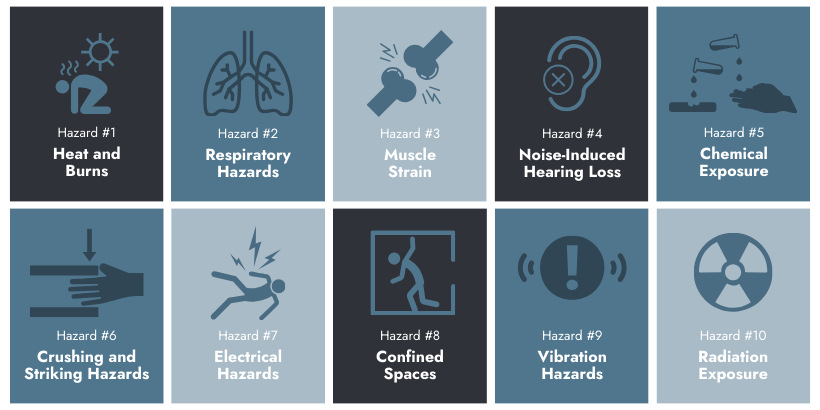

Table of Contents
- 1. Heat Burns
- 2. Noise-Induced Hearing Loss
- 3. Muscle Strain
- 4. Respiratory Hazards
- 5. Chemical Exposure
- 6. Physical Hazards
- 7. Electrical Hazards
- 8. Confined Spaces
- 9. Vibration Hazards
- 10. Radiation Exposure
1. Heat Burns
In the steel industry, temperatures and humidity run high, exposing workers to intense heat from molten metal, furnaces, and welding tasks.
Furnace operators, casters, and rolling mill workers face radiant heat, molten metal splashes, and direct contact with surfaces that can exceed
1000°C. The risks extend beyond immediate burns: prolonged exposure to high heat causes heat exhaustion, heat stroke, dehydration, and muscle cramps.
Workers who have not acclimatized yet to these conditions need structured training on heat stress recognition and mandatory rest rotations
in shaded or cooler areas. A hydration protocol, at minimum one cup of water every 15 to 20 minutes should be the standard operating procedure.
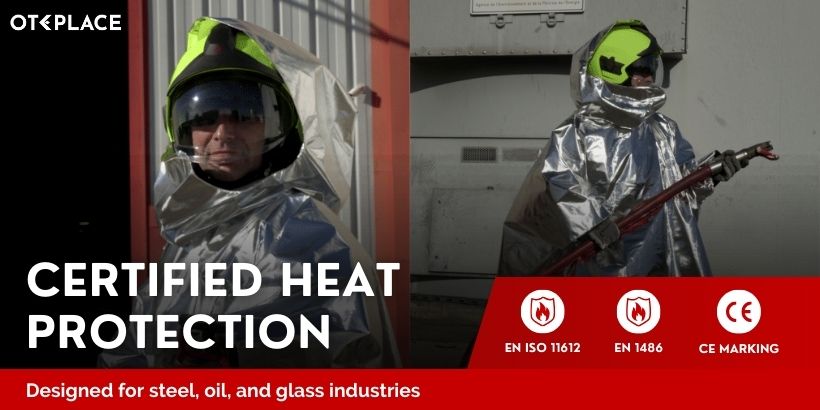
Recommended PPE for Heat Burns
Heat resistant suits, aprons, and gloves rated to
EN ISO 11612
and EN 406. Aluminized face shields and safety goggles for molten metal splash protection can protect workers.
2. Noise-Induced Hearing Loss
Rolling mills, presses, and grinding operations routinely exceed 100 – 110 dB, well above
OSHA’s 90 dBA
threshold for an 8-hour shift. Unlike burns, noise damage is invisible and cumulative.
Beyond individual health, high noise environments can interfere with communication between employees, resulting in nervous fatigue and an increased risk of occupational injury.
Implementing hearing protection, conducting regular noise assessments, and engineering controls like noise-reducing barriers are crucial in preventing noise-induced hearing loss among workers.
Recommended PPE for Noise Reduction
Earmuffs for high-intensity areas above 95 dB.
Communication devices
team communication while blocking harmful noise levels are increasingly standard in steel facilities.
3. Muscle Strain & Ergonomic Injuries
Steelworkers often engage in repetitive tasks, handle heavy loads, or work in awkward positions, leading to ergonomic hazards.
Prolonged exposure to these conditions can result in musculoskeletal disorders (MSDs) or muscle strain like tendonitis, carpal tunnel
syndrome, or back injuries. To mitigate these risks, implementing ergonomic assessments, providing adjustable workstations, using ergonomic
tools, and offering training on proper posture and movement techniques can help reduce ergonomic risks.
Recommended PPE for Muscle Strain
Back support belts for manual handling tasks. Anti-vibration gloves for tool-intensive roles.
Knee pads
for workers in sustained kneeling positions. Anti-fatigue mats at fixed standing workstations.
4. Respiratory Hazards
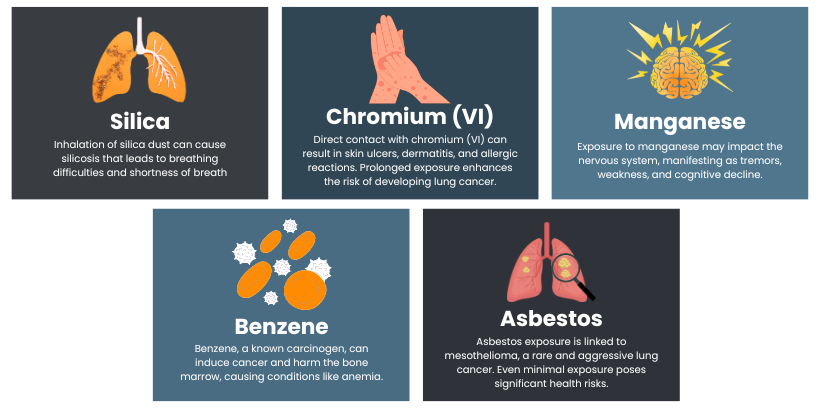
Steel production releases a mixture of airborne hazards: silica dust from raw materials, metal fumes from smelting and welding, carbon monoxide and benzene from
combustion processes, and in older facilities, legacy asbestos. Each carries a different risk profile, from immediate irritation to long-term silicosis, emphysema,
and occupational lung cancer.
Asbestos and other chemicals like carbon monoxide and benzene add to the dangers. Silica dust is particularly harmful, causing silicosis upon inhalation.
Respiratory protection must be specified based on site-specific air quality data. Procurement teams should not apply a generic solution across the whole
facility, the respirator required in the smelting area is not the same as the one needed in the maintenance workshop.
Recommended PPE for Respiratory Protection
N95 / FFP3 disposable respirators for dust and particulate control. Half-face respirators with chemical cartridges for fume and gas exposure. Powered air-purifying respirators (PAPR) for enclosed or high-concentration areas. Supported by regular air quality monitoring and occupational health surveillance.
5. Chemical Exposure
Steel manufacturing processes frequently use chemicals like acids, solvents, and cleaning agents. These
substances may present a hazard when coming in contact with the body or absorption into the body. Improper handling or
accidental spills can expose workers to these hazardous substances, leading to short-term issues such as skin irritation,
chemical burns, or long-term health effects.
Strict adherence to safety protocols, comprehensive training, and appropriate personal protective equipment are imperative to mitigate chemical exposure risks.
Recommended PPE for Chemical Exposure
Chemical-resistant nitrile or
neoprene gloves
, graded by EN 374 for the specific chemicals in use. Chemical splash goggles (indirect-vent) and full face shields for high-splash tasks. Acid-resistant aprons and coveralls. Emergency eyewash stations within 10 seconds of any chemical handling area.
6. Physical Hazards
Heavy steel coils, billets, and sheets, combined with overhead cranes, forklifts, and conveyor systems, create a constant risk of crushing and struck-by injuries. These incidents are among the most severe in the industry: a dropped load or a vehicle in a blind spot can be fatal.
Machine guarding, clearly marked exclusion zones, and rigorous operator training are the engineering and procedural answers. Workers in proximity to heavy moving materials need PPE that provides protection when something goes wrong despite those controls.
Recommended PPE for Physical Hazards
Steel-toed boots, hard hats, and high-visibility
vests for general safety. Additionally, gloves and specific body protection gear
when working near moving machinery or heavy equipment.
7. Electrical Hazards
The steel sector heavily relies on electrical equipment and machinery, where
issues such as faulty equipment, faulty connections, and failure to adhere to
SOPs can cause safety hazards. If proper precautions are not taken, working with
electricity poses a significant risk of electric shocks, burns, or even
electrocution. Regular inspections, adequate maintenance, grounding systems, and
training on electrical safety procedures are essential to prevent electrical accidents.
Recommended PPE for Electrical Hazards
Insulated gloves, footwear, and mats to protect against electrical shocks. Additionally,
arc flash suits
or flame-resistant clothing are used for those working with high-voltage equipment.
8. Confined Spaces
Furnace interiors, tanks, pits, and ducts are common confined spaces in steel facilities. The hazards are layered: limited entry and exit points,
poor or no natural ventilation, and potential for oxygen deficiency and toxic gas accumulation, particularly carbon monoxide. Workers can lose consciousness with little warning.
Confined space entry requires a formal permit system, continuous atmospheric monitoring, and a standby person who can initiate rescue without entering the space. These are procedural requirements, but the PPE must be in place to support them.
Recommended PPE for Confined Spaces
Safety harnesses, lifelines, self-contained breathing apparatus (SCBA), gas detectors, headlamps, and protective clothing designed for confined spaces.
9. Vibration Hazards
Workers using vibrating tools or machinery are at risk of developing
hand-arm vibration syndrome (HAVS)
. This condition can cause numbness, tingling, reduced dexterity, or even permanent nerve damage in the hands and arms.
Recommended PPE for Vibration Hazards
Anti-vibration gloves designed to reduce exposure to hand-arm vibration, as well as vibration-dampening materials in tool handles or machinery.
10. Radiation Exposure
Two distinct radiation sources exist in steel plants. Non-ionizing radiation, UV and infrared from welding arcs and furnaces, causes arc eye, cataracts, and skin burns. Ionizing radiation from NDT equipment, including X-ray and gamma-ray systems used for weld inspection, requires a formal radiation safety programme and worker dosimetry.
Welding UV is more pervasive than many safety programmes acknowledge. Bystanders without eye protection near arc welding operations are at risk even several metres away. NDT operations must have defined controlled zones and trained radiation safety officers.
Recommended PPE for Radiation Exposure
Radiation shielding gear like lead aprons, gloves, goggles, face shields, or specialized clothing.
What Workers Feel About Safety and Hazards in Steel Industry
In an industry filled with heavy machinery and tools, workers in metal and steel
are expressing growing worries about the lack of attention to their well-being
at work. A recent study highlighted that about a third of metalworkers feel that
occupational health and safety should be given more importance in their
workplaces. What’s more concerning is that more than a quarter feel uncertain
about their safety while working. While some, around 38%, feel confident in
their job safety, a significant 45% believe that tools designed with better
safety features could significantly improve their comfort and security at work.
In the past, entities such as United States Steel Corp. and Bethlehem Steel faced
scrutiny from the Occupational Safety and Health Administration (OSHA) due to
their inadequacies in safeguarding workers. In 2016, U.S. Steel in Pennsylvania
received a fine of $170,000 for subjecting workers
to asbestos exposure.
Building a Steel Plant Safety Programme: What to Prioritise
For safety officers and plant managers responsible for a facility’s PPE programme:
-
Conduct a site-specific risk assessment mapping hazards by zone and role.
-
Source PPE to the specific hazard level in each zone. A worker at the furnace needs different heat protection than one in the maintenance bay
-
Verify supplier certifications before purchasing. For steel environments, look for EN ISO 11612, EN 407, EN 374, EN ISO 20345, and OSHA-compliant equivalents.
-
Implement regular PPE inspection cycles and defined replacement schedules. Degraded PPE is non-compliant PPE.
-
Build a confined space entry permit system with atmospheric monitoring and retrieval equipment in place before any entry.
-
Establish emergency response protocols for the specific hazards present: arc flash, chemical spill, confined space rescue, and heat emergency all require different responses.