
Working with metal casting presents a unique set of potential hazards, ranging from burns and lacerations to exposure to hazardous materials. To protect metal casting workers from being exposed to these dangers in the workplace, employers need to make use of protective equipment (PPE).
This guide covers the core PPE categories used in metal casting and foundry operations, followed by the operational practices and training that determine whether the equipment actually does its job.
Table of Contents
- Safety Helmets
- Safety Glasses/Face Shields
- Respiratory Protection
- Hearing Protection
- Foundry Jackets
- Aprons
- High-temperature Sleeves
- Aluminised Leggings
- Gloves
- Safety Footwear
- Heat-resistant Clothing
PPE for Metal Casting Operations
The categories below are organized head-to-toe. Specific product selection within each category depends on the dominant hazard at the workstation (molten splash, radiant heat, chemical exposure, or or mechanical risk) and the standards required in your operating jurisdiction.
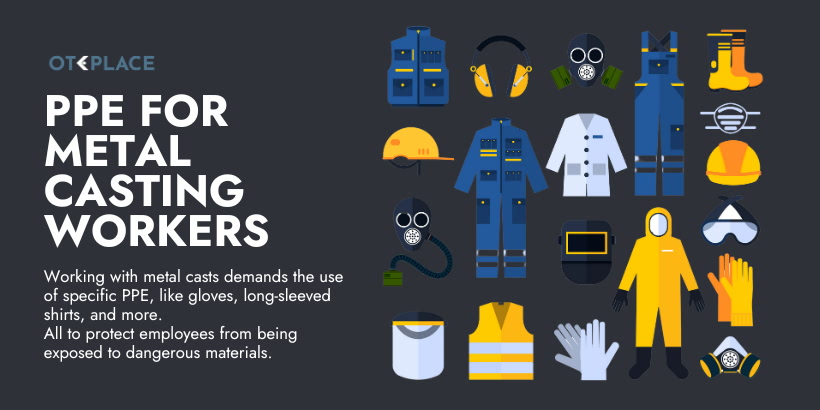
1. Safety Helmets
Protect against falling objects, accidental contact with overhead structures, and elevated temperatures. For foundry use, helmets should be heat-resistant and capable of withstanding elevated temperatures without deformation. Common standards include ANSI Z89.1 (US) and EN 397 (Europe). A heat-rated chinstrap matters for work where the helmet might be dislodged.
↑ Return to top
2. Safety Glasses/Face Shields
Safety glasses with shatter-resistant polycarbonate lenses cover general flying-debris risk. Full face shields are required for tasks involving molten metal proximity, grinding, and chemical splash. Gold-coated or tinted visors are common for furnace and pouring work to manage radiant heat and glare. Anti-fog coatings are worth specifying for hot, humid foundry environments.
↑ Return to top
3. Respiratory Protection
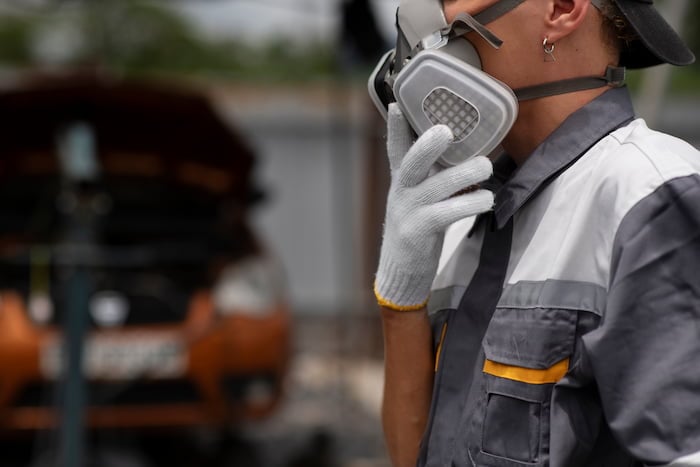
Foundry air contains metal fume from melting (zinc, manganese, lead in some alloys), silica dust from sand mold preparation and shakeout, and combustion gases including carbon monoxide from cupolas and furnaces. Respirator selection depends on the specific exposure. Disposable particulate respirators handle general dust loads, while powered air-purifying respirators (PAPRs) or supplied-air systems are required for high-concentration zones. Generic dust masks are not sufficient for metal fume or fine silica. Fit testing is mandatory for any tight-fitting respirator.
↑ Return to top
4. Hearing Protection
In the metal casting industry, earplugs or earmuffs are often worn to protect against noise generated by machineries such as furnaces, foundry ladles, and air compressors. They can also help protect against hearing loss caused by exposure to high noise levels over time.
↑ Return to top
5. Foundry Jackets
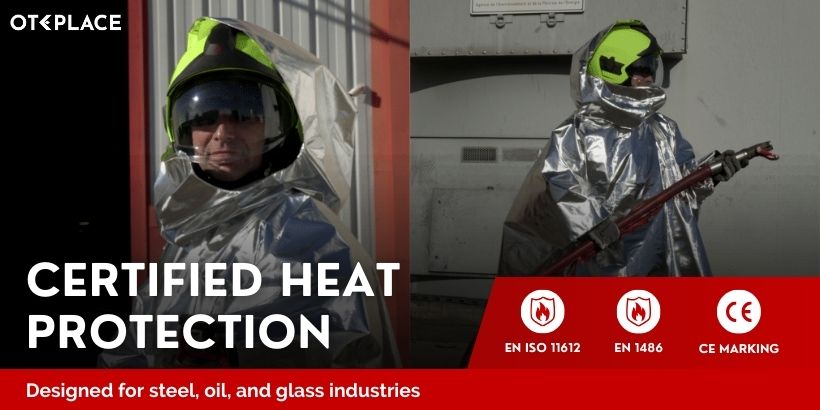
A foundry jacket is a heavy-duty coat that is worn to protect workers from high temperatures and molten metal splash. Foundry jackets are often made of materials such as aluminized viscoses or aramids. In the metal casting industry, they help protect workers from being burned by hot metals or coming into contact with dangerous chemicals.
↑ Return to top
6. Aprons
Worn over the jacket or workwear to add a barrier across the front of the body during pouring, tapping, and close-work operations. Aluminised glass-fibre and aramid aprons are common in foundry use. The added layer addresses the highest-exposure body area without requiring full proximity gear.
↑ Return to top
7. High-temperature Sleeves
High-temperature sleeves are made of a heat-resistant material and are worn over the arms to protect them from heat and sparks.
↑ Return to top
8. Aluminised Leggings
Protect the legs from waist to ankle against molten splash and radiant heat. Typically worn over standard workwear. Specified for proximity work where lower-body exposure is significant, particularly during pouring and tapping operations.
↑ Return to top
9. Gloves
Gloves are worn to protect the hands from hot metals and other hazards. They are usually made of fire-resistant materials such as glass fibers or aramids.
↑ Return to top
10. Safety Footwear
Steel-toed boots with heat-resistant soles protect against falling objects, molten metal splash, and hot surfaces. For casting environments, look for smooth boot fronts that shed splash rather than catch it, metatarsal protection for shakeout and heavy-lifting areas, and certification to ASTM F2413 (US), EN ISO 20345 (Europe), or the equivalent in the operating jurisdiction.
↑ Return to top
11. Heat-resistant Clothing
Heat-resistant clothing is made of a special fabric that does not burn easily. It is often used in foundries and other environments where there is exposure to high temperatures or flames. Heat-resistant clothing includes gloves, aprons, jackets, trousers, and boots.
↑ Return to top
Safe Work Practices
Working in any type of industrial environment is dangerous. The metal casting industry is no exception. However, with the right safety practices, you can protect your employees and your business from unnecessary risk.
Here are a few safety practices to follow on-site to ensure employee safety and health while minimizing your business’s liability exposure at the same time.
Proper Machine Guarding
Machine guarding involves the installation of physical barriers to prevent workers from coming into contact with moving parts on machinery used in the metal casting process. Properly installed machine guards can also help reduce noise levels and keep dust particles at bay.
It’s important to consult with a qualified professional when designing and installing machine guards, as some machines have certain requirements that must be met to ensure their safe operation.
Fire Prevention
All fire prevention measures must be followed when dealing with molten metals like aluminum and zinc because these materials are highly flammable. Every workspace should have marked fire exits, fire extinguishers located throughout the area, and emergency response plans in place if a fire does occur. Additionally, it’s important to keep combustible materials away from any open flames or heated metals.
Lockout/Tagout Procedures
The lockout/tagout procedure is an important part of any safety program in the metal casting industry. This procedure involves locking out or tagging out all energy sources before performing maintenance or repairs on equipment.
By doing this, it ensures that no one will accidentally come into contact with live electricity while repairs are being performed. This procedure should always be followed whenever maintenance or repairs are needed on any type of equipment used in the metal casting process.
Engineering Controls
Local exhaust ventilation at fume and dust emission points, enclosure of high-emission processes, radiant heat shielding at fixed work positions, and ergonomic workstation design reduce exposure before PPE has to compensate.
Training and Education
Working in metal casting is a difficult job, but one that can be made easier with the proper training and education. For professionals in this field, it is essential to know about metal casting processes, risk assessment, and proper PPE use.
This knowledge can be acquired through specialized training courses and certifications. Let’s take a closer look at the benefits of training and education for metal casting professionals.
Benefits Of Training
Training is key to developing a knowledgeable, competent workforce that understands the safety requirements associated with metal casting operations. It also allows workers to become more familiar with the process and develop better problem-solving skills to handle any challenges that may arise. Furthermore, employers are likely to have access to lower insurance premiums when their employees are properly trained following industry standards.
Training courses provide an in-depth overview of topics such as risk assessment, PPE use, process control techniques, quality control procedures, troubleshooting methods, etc. This type of hands-on learning allows workers to gain a deeper understanding of how each element works together to ensure safe operations throughout the entire process. Additionally, many courses offer certificates upon completion so that workers can demonstrate their competence on the job site.
Benefits Of Education
Education plays an important role in helping employees understand the fundamentals behind metal casting processes so they can make informed decisions about how best to approach each task or operation. Educational programs often teach workers how to identify potential hazards associated with different aspects of their work and then apply appropriate solutions or countermeasures accordingly.
They also help technicians become proficient in various metallurgy techniques used in the industry today such as heat treating metals or analyzing grain structure using microscopy analysis tools.
Case Studies
There have been numerous cases in the past involving disabling and non-disabling accidents in the metal casting industry as well as foundries. The constantly changing specifications from product to product make it impossible to standardize operations and workers are required to be fewer specialists and be more versatile with various types of foundry operations.
While molding and demolding are average on the scale of possible metal casting accidents, melting metal, cleaning, chipping, and finishing are the most hazardous elements of the process that pose a higher range of accidents among metal casting workers.
Practically, almost all workers are subject to certain hazards despite their operation on the work floor. Every worker faces the risk of getting their toes or fingers crushed while moving heavy materials with more chances of sprains. When in the vicinity of pouring molten metal into molds, the possibility of getting burnt by metal splashes is common.
Piled materials and the shifting of materials overhead via cranes and lifts are other possible dangers lurking around the corners.
Defective Equipment
In one injury case, defective casting equipment was at the core of the issue resulting in the death of one worker and causing second and third-degree burns to three others. Four workers were involved in the metal pouring process when the casting die filled with the molten metal ruptured, throwing the liquid metal on the workers. The equipment lacked proper safety guards and was poorly designed concerning other safety features.
Occupational Hazard
In a more unsettling incident, the monitoring equipment of a facility malfunctioned, after which a breakdown team was dispatched to the spot to undertake repairs. However, the efforts were uncoordinated with the operational management and resulted in more serious predicaments.
While hazardous gases started escaping the facility, a team of firefighters was sent in to rectify the situation without any clue of the concentration of the gasses. This series of errors, both manual and mechanical, resulted in the death of three people and serious gas poisoning of various degrees for 22 other people involved.
In studies targeting such metal casting accidents, statistics reveal that simply having immediate medical attention on site drastically reduces the overall rate of injuries and serious health issues. And while in most cases the workers are blamed for such mishaps, oftentimes, defective equipment and errors like unplanned coordination, communication, and lack of situational awareness result in equally life-threatening accidents.
Final Thoughts On The Risks Of Metal Casting
The metallurgy and foundry industries are involved in the production of essential raw materials for a variety of products. Understanding the metal casting process is essential to help improve risk assessment and hazard identification. Creating an action plan to address the identified risks and using the appropriate PPE when dealing with molten metals can help prevent injuries and deaths.
Safe work practices should always be followed on-site such as proper machine guarding, fire prevention measures, lockout/tagout procedures, and engineering controls. Training and education are necessary for professionals in this field to understand safety requirements, gain problem solving skills, become familiar with processes and develop proficiency in metallurgy techniques.
For procurement teams sourcing PPE for foundry and metallurgy operations, the metallurgy category on OTEPLACE is the starting point. The team handles specialised and volume requests through the contact page.
FAQ Section
What PPE should be worn with metal casting?
At minimum, head protection, eye and face protection, heat-resistant body protection (jacket, apron, or aluminised gear depending on proximity), gloves rated for the relevant heat exposure, leg protection for close-work positions, and steel-toed heat-resistant footwear. Respirators and hearing protection are required where the specific exposures justify them.
What are some safety hazards in metal casting?
Molten metal splash and contact, radiant heat exposure, respiratory hazards from metal fume and silica dust, falling and projectile hazards from heavy materials and shakeout operations, hot surface contact with castings and equipment, and sustained noise exposure from grinding and pneumatic tools.
What are safe work practices in metal casting?
Machine guarding on moving equipment, fire prevention procedures around molten metal, lockout/tagout for maintenance, engineering controls including ventilation and heat shielding, and workstation-level risk assessment with documented review intervals.
What are the benefits of training and education for metal casting professionals?
Reduced incident rates, lower insurance exposure, faster and more coordinated emergency response, better hazard recognition at the workstation level, and improved compliance with PPE programmes over time.