

S1, S2, S3S and S7S Safety Shoes: What’s the Difference?
Choosing the right safety shoes involves more than finding a comfortable fit or a durable outsole. Different working environments expose employees to different hazards, from falling objects and sharp materials to wet surfaces and challenging outdoor conditions.
To help identify appropriate protection, safety footwear is categorized according to specific performance requirements. Under the European EN ISO 20345 standard, classifications such as S1, S2, S3S, and S7S indicate the protective characteristics a shoe is designed and tested to provide.
However, these classifications are not interchangeable. Understanding what each one means can help employers, safety managers, and workers make more informed footwear decisions.
This guide explains the main safety shoe classifications, how they differ, and what to consider when selecting protective footwear.
What Is EN ISO 20345:2022?
EN ISO 20345 is a European standard that establishes performance requirements for safety footwear intended to protect against workplace hazards.
Footwear certified under this standard must meet fundamental requirements, including protective toe caps designed to withstand impact energy of 200 joules and compression forces of 15 kilonewtons.
Beyond these basic requirements, additional classifications identify specific protective features, such as penetration resistance, antistatic properties, heel energy absorption, and water resistance.
The EN ISO 20345:2022 revision introduced updated classifications and more specific testing distinctions, particularly for penetration-resistant footwear.
For example, classifications such as S3S and S7S identify footwear with particular penetration-resistance properties that were not distinguished in the same way under the previous edition.
Products certified under earlier editions may still be encountered in the market. Buyers should therefore check both the classification and the standard edition listed in the manufacturer’s documentation.
Understanding S1, S2, S3, S3S and S7S Safety Shoes
Each safety shoe classification represents a combination of protective features.
Although some categories build on the requirements of others, selecting the highest available classification is not always necessary. The appropriate choice depends on the hazards identified in the workplace.
S1 Safety Shoes: Basic Protection for Dry Workplaces
S1 safety shoes are generally intended for working environments where protection against impact and compression is necessary, but additional water resistance or penetration protection is not required.
In addition to the basic safety footwear requirements, S1 footwear includes a closed heel area, antistatic properties, and energy absorption in the heel region.
These characteristics can make S1 footwear appropriate for certain indoor workplaces, including warehouses, logistics facilities, and manufacturing environments.
However, S1 classification alone does not indicate protection against sharp objects penetrating the sole.
Where underfoot hazards are present, employers should consider footwear with the appropriate penetration-resistance certification.
S2 Safety Shoes: Additional Water-Resistant Upper Protection
S2 safety shoes incorporate the protective characteristics of S1 footwear while adding requirements for resistance to water penetration and absorption through the upper material.
This makes S2 footwear worth considering in environments where workers may encounter occasional moisture or damp conditions.
For example, certain manufacturing, maintenance, or industrial processing environments may require footwear that provides some resistance to moisture without the additional penetration protection associated with other classifications.
However, an important distinction exists between water-resistant uppers and whole-footwear water resistance.
S2 footwear is not automatically waterproof. Water may still enter through other areas of the shoe, depending on its construction and exposure conditions.
S3 Safety Shoes: Penetration Resistance and Cleated Outsoles
S3 safety shoes build on S2-level protection by incorporating penetration resistance and a cleated outsole.
These additional characteristics are relevant in workplaces where sharp materials, debris, or uneven ground may create underfoot hazards.
Under EN ISO 20345:2022, the S3 classification identifies footwear with metallic penetration-resistant inserts. The revised standard also distinguishes nonmetallic penetration protection through the S3L and S3S classifications.
This distinction matters because different penetration-resistant inserts are evaluated using different test methods.
S3 footwear may be suitable for certain construction, maintenance, and industrial environments, provided its protective characteristics match the actual workplace hazards.
S3S Safety Shoes: Nonmetallic Penetration Protection Tested with a 3 mm Nail
S3S safety shoes provide S2-level protective characteristics, penetration resistance, and a cleated outsole.
The distinguishing feature is the type of penetration resistance.
Under EN ISO 20345:2022, the PS designation identifies nonmetallic penetration-resistant inserts tested using a 3.0 mm test nail.
This differs from the PL designation, which identifies nonmetallic inserts tested using a 4.5 mm nail.
The smaller test nail is intended to evaluate resistance against narrower penetrating objects.
S3S footwear may be appropriate in environments where sharp debris, nails, or other underfoot hazards require this type of protection.
However, certification should not be interpreted as a guarantee against every possible sharp object or penetration scenario.
S7S Safety Shoes: S3S-Level Protection with Whole-Footwear Water Resistance
S7S safety shoes combine the protective characteristics associated with S3S footwear with an additional whole-footwear water resistance requirement.
Like S3S, this classification includes nonmetallic penetration resistance tested using a 3.0 mm nail and a cleated outsole.
The key difference is the addition of whole-footwear water resistance, identified by the WR requirement.
This makes S7S footwear particularly relevant when workers face both underfoot hazards and exposure to wet working conditions.
Examples may include certain outdoor construction, infrastructure maintenance, and industrial operations involving frequent contact with water.
However, whole-footwear water resistance does not mean unlimited waterproof performance under every condition.
Buyers should review the manufacturer’s specifications and intended use, particularly when footwear may be exposed to prolonged immersion or demanding environmental conditions.
S1 vs. S2 vs. S3S vs. S7S: Key Differences
The main differences between these safety shoe classifications involve water resistance, penetration protection, and outsole construction.
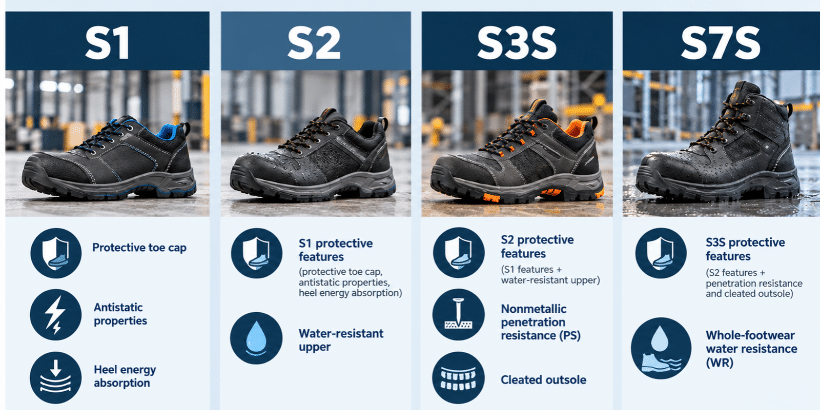
S1 safety shoes provide basic protective features, including toe protection, antistatic properties, and heel energy absorption. They are generally suitable for dry working environments where additional penetration or water resistance is not required.
S2 safety shoes build on S1 protection by adding resistance to water penetration and absorption through the upper material. However, they do not automatically provide whole-footwear water resistance.
S3S safety shoes add nonmetallic penetration resistance tested using a 3.0 mm nail, along with a cleated outsole. These features make them relevant for workplaces where sharp objects and underfoot hazards are present.
S7S safety shoes provide the protective characteristics of S3S while adding whole-footwear water resistance. They may be appropriate for environments where workers encounter both sharp objects and wet conditions.
Other classifications, including S1P and S3, provide alternative combinations of protective features depending on workplace requirements.
What Do Additional Safety Footwear Markings Mean?
Understanding the main classification is important, but additional markings provide further information about specific protective characteristics.
These markings can help safety professionals identify footwear suited to particular workplace conditions.
P, PL, and PS: Penetration Resistance
Under EN ISO 20345:2022, penetration-resistance markings distinguish between different insert materials and test methods.
P identifies metallic penetration-resistant inserts tested with a 4.5 mm nail.
PL identifies nonmetallic inserts tested with a 4.5 mm nail, while PS identifies nonmetallic inserts tested with a 3.0 mm nail.
These distinctions are especially relevant when selecting puncture resistant safety shoes for workplaces where sharp materials may be present.
WR: Whole-Footwear Water Resistance
The WR marking indicates that the complete footwear has been tested against specified water resistance requirements.
This differs from the water penetration and absorption requirements associated with the upper material alone.
Workers who regularly encounter wet conditions should understand this distinction before choosing between water resistant safety shoes and footwear with whole-footwear water resistance.
SR: Additional Slip Resistance
Slip resistance is another important consideration, particularly in workplaces with wet or contaminated walking surfaces.
EN ISO 20345:2022 includes basic slip-resistance requirements and an optional SR marking for footwear that passes additional testing under specified conditions.
Older footwear may display SRA, SRB, or SRC markings from previous editions of the standard.
These older markings should not be confused with the updated SR designation.
Even when footwear meets slip-resistance requirements, actual performance depends on factors such as floor materials, contaminants, wear, and maintenance.
HI and CI: Thermal Insulation
HI indicates insulation against heat, while CI indicates insulation against cold.
These markings may be relevant for workers exposed to temperature-related hazards.
However, the presence of thermal insulation does not replace the need to evaluate other protective requirements.
How to Choose the Right Safety Shoes for Your Workplace
Choosing appropriate protective footwear begins with understanding the working environment rather than selecting a classification based on its name alone.
Assess the Hazards in Your Work Environment
Different workplaces present different footwear risks.
Warehouse workers may need protection against falling materials, while construction workers may encounter sharp debris and uneven surfaces.
Outdoor maintenance teams may face wet conditions, and industrial facilities may require additional protection against slipping or exposure to particular environmental hazards.
A workplace hazard assessment helps determine which protective features are necessary.
Select the Classification That Matches Those Hazards
Once the hazards have been identified, employers can compare the available safety shoe classifications.
S1 may be appropriate for certain dry indoor workplaces where penetration protection is not required.
S2 adds water-resistant upper properties, while S3S provides specific nonmetallic penetration protection and a cleated outsole.
Where both penetration resistance and whole-footwear water resistance are necessary, S7S may be worth considering.
S1P is another option when penetration resistance is needed without all the additional requirements associated with S3-level footwear.
These examples are general guidance, not substitutes for a workplace-specific assessment.
Verify the Standard Edition and Product Markings
Before purchasing safety footwear, check the manufacturer’s documentation to confirm the applicable certification.
Pay particular attention to whether the product references EN ISO 20345:2011 or EN ISO 20345:2022.
This matters because classification markings and testing requirements have changed.
Employers should also verify any additional protective features required for their workplace, including slip resistance, penetration resistance, and electrical properties.
EN ISO 20345 vs. ASTM F2413: What US Buyers Should Know
Although EN ISO 20345 is widely recognized internationally, it is important to distinguish European safety footwear classifications from US requirements.
In the United States, protective footwear is commonly evaluated against ASTM F2413, which establishes performance requirements for protective toe footwear and other specified hazards.
The two standards use different classification and marking systems.
For example, an S3S or S7S classification should not automatically be treated as equivalent to a particular ASTM F2413 rating.
Under OSHA’s general industry protective footwear requirements, employers must ensure affected employees use appropriate protective footwear when relevant foot hazards are present.
US buyers should therefore verify that selected footwear meets applicable workplace requirements and the relevant OSHA-recognized consensus standards.
European certification may provide useful product information, but it should not be assumed to establish compliance with US requirements on its own.