ABEK1P3 : what does this marking mean on a respirator filter?
In industry, workers may be exposed to multiple contaminants at the same time. In particular, vapors and aerosols can form during the spraying, mixing, or rinsing of chemical products. In this type of environment, a standard respirator mask is not always sufficient.
That’s where ABEK1P3 filters come in.
ABEK1P3 is a classification used in European standards. This marking indicates the different gases, vapors, and particles the filter is designed to protect against. For HSE managers and procurement teams, understanding this marking is essential. It helps you select suitable protection for environments featuring multiple hazards.
In this guide, we explain the meaning of A, B, E, K, 1 and P3. We’ll also look at how an ABEK1P3 filter works and how to choose the right respiratory protection system.
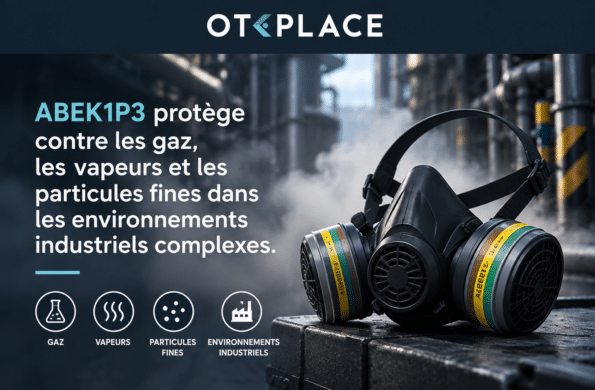
What does ABEK1P3 mean?
Each letter in the marking ABEK1P3 corresponds to a type of contaminant. The associated color code also makes it easier to identify the type of protection provided by the cartridge.
| Marking | Protection | Examples | Color |
| A | Organic vapors with a boiling point > 65 °C | Solvents, paints, fuels | Brown |
| B | Inorganic gases | Chlorine, hydrogen sulfide | Gray |
| E | Acid gases | Sulfur dioxide, hydrogen chloride | Yellow |
| K | Ammonia and derivatives | Refrigeration, agriculture | Green |
| P3 | High-efficiency particles | Fine dust, mists, aerosols | White |
So an ABEK1P3 filter provides protection against several categories of contaminants. This includes organic and inorganic vapors, acid gases, and ammonia. It also filters fine dust and other particles. However, this protection has limits.
An ABEK1P3 filter does not protect against carbon monoxide. It must also not be used in an oxygen-deficient atmosphere.
What does the “1” figure mean in ABEK1P3?
The number indicates the gas filter capacity class.
A Class 1 corresponds to a maximum concentration up to 0.1% by volume. It is generally suitable for low to moderate industrial exposure. A Class 2 can be used up to a concentration of 0.5% by volume. It therefore corresponds to environments with higher concentrations.
How does an ABEK1P3 filter work?
Understanding how a filter works helps you better assess its service life and limitations. An ABEK1P3 filter combines several filtration mechanisms.
Adsorption using activated carbon
Cartridges for gases contain activated carbon. When contaminated air passes through the cartridge, vapors bind to the surface of the carbon. The amount of activated carbon therefore influences the filter’s potential service life. However, several factors can reduce its performance. This is especially true for humidity, temperature, and the concentration of contaminants.
Chemisorption
Some reactive gases require a different mechanism. For example, sulfur dioxide requires a chemical bond with treated carbon. This process improves protection. However, this protection applies only to specific types of gases for which the filter is certified according to the standard EN 14387.
Mechanical filtration P3
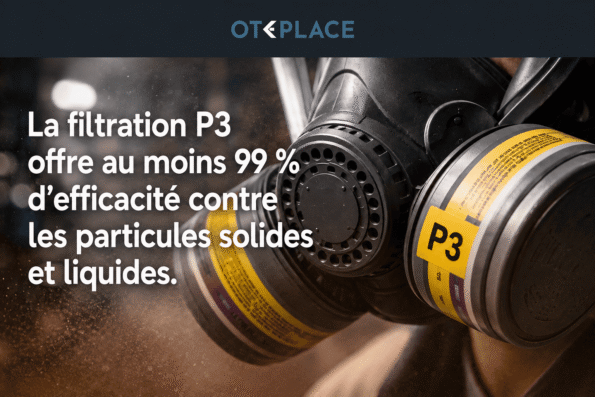
The P3 portion concerns particles. The P3 filter captures at least 99% of solid and liquid particles. This includes fine dust, mists, and fumes.
Which industries use an ABEK1P3 filter?
Thanks to its combined protection, ABEK1P3 can be used in a range of industrial applications.
It is particularly suitable for:
- industrial painting;
- spraying chemical products;
- touch-up work and automotive painting;
- handling pesticides;
- maintenance operations involving solvents and dust.
These cartridges are frequently used with half masks and full-face masks in industrial environments.
Half mask, full-face mask, or PAPR: what should you choose?
Choosing the right cartridge is only one part of the protection. The type of respirator also plays an important role in the performance achieved in real conditions.
An elastomer half mask provides an assigned protection factor (APF) of approximately 10 to 30. It requires a fit test. An elastomer full-face mask provides an APF of around 50. It ensures a better seal and also protects the eyes. A PAPR with a loose-fitting hood generally provides an APF between 25 and 50. It offers greater comfort and does not require a tight-fitting face seal. Finally, a PAPR with a full-face mask can achieve an APF of about 500 to 1,000. This provides a very high level of protection.
However, these values may vary by jurisdiction.
In practice, full-face masks provide higher overall protection and also cover the eyes. Half masks are lighter. They are often used in environments with a moderate risk level.
Why use a combined ABEK1P3 filter?
Combined filters bring two types of protection together in a single system: a cartridge for gases and a filtering section for particles. So the choice depends on the contaminants present.
For exposure to gases only, an ABEK cartridge can be used. For particles only, a P3 particle filter is suitable. On the other hand, when an environment has both gases and dust, a combined ABEK1P3 filter may be required.
However, it’s important not to consider ABEK1P3 as a universal solution. A single cartridge does not cover all chemical risks. For example, mercury vapors require specialized filters.
What is the service life of an ABEK1P3 filter?
The service life of a filter depends on several variables.
When it’s not in use, the filter must remain sealed until its expiry date. Its shelf life is often five years.
Storage conditions are also important. The document recommends a temperature between 10 and 30 °C and humidity below 80%.
Once in service, the filter should be replaced when the user detects a smell or taste. An increase in breathing resistance can also indicate that replacement is necessary.
A gas filter is considered saturated when the user begins to sense or taste the vapors. It should then be replaced immediately.
Finally, the concentration of contaminants directly affects its usable life. The higher the concentration, the shorter the filter’s service life.
How do you set up suitable respiratory protection?
The performance of a cartridge also depends on the mask and how well it fits. Good respiratory protection therefore needs to be part of a broader approach.
1. Assess the risks
Identify the gases, vapors, and particles present in the work environment.
2. Select the filter
Choose a cartridge suited to the identified contaminants.
3. Choose the mask type
Determine whether the user needs a half mask, a full-face mask, or a PAPR.
4. Perform a fit test
The test must be carried out before using the respirator.
5. Set up an operating protocol
Any symptoms should be monitored during work.
6. Maintain the equipment
Regularly inspect the seals. Also replace filters when necessary.
7. Store the equipment properly
Equipment must be kept closed and dry.
8. Train users
Training is essential. Documentation related to respiratory protective equipment must also be kept up to date. Face-fitted respirators require an appropriate fit test. Facial hair can compromise the mask’s seal.
What are the limitations of an ABEK1P3 filter?
Even though ABEK1P3 covers several types of contaminants, there are important limitations.
ABEK1P3 filters:
- do not protect against carbon monoxide ;
- must not be used in an oxygen-deficient atmosphere ;
- must comply with standards EN 14387 and EN 143 ;
- must be replaced immediately when saturated.
These limitations must be taken into account before choosing respiratory protection.
How to choose the right ABEK1P3 cartridge?
Choosing an ABEK1P3 cartridge is not just about understanding the letters on its label. First and foremost, you must check that the protection level matches the real hazards of the work environment.
Before purchasing:
- carry out a documented risk assessment;
- identify the substances present precisely;
- do not rely on assumptions;
- check compliance with the standard EN 14387 and any other applicable European standards;
- verify the cartridge compatibility with the chosen mask;
- ensure users are trained and have completed a fit test.
ABEK1P3: versatile protection, but not universal
A safety officer inspecting an ABEK1P3 cartridge with a worker in a warehouse. At Oteplace, we regularly find that ABEK1P3 is presented as a universal solution. However, that’s not the case. An ABEK1P3 filter covers a wide range of contaminants. It can protect against organic vapors, inorganic gases, and acid gases. It also covers ammonia and fine dust.
However, the filter must always precisely match the exposure levels and the oxygenation conditions of the environment.

The cartridge must match the hazard. The mask must be properly fitted to the user. Finally, the entire system must be consistent with the risk assessment.
To discover certified ABEK1P3 cartridges and compatible respiratory systems compliant with European standards, check out the Oteplace selection for industrial environments and maintenance operations.