Firefighter PPE is one of the few procurement categories where the gear has to match the intervention, not just the wearer. A structural turnout designed for residential and commercial fires is the wrong choice for a wildland deployment. A wildland kit will not protect against a chemical spill. A hazmat ensemble is too heavy for a technical rescue. Treating firefighter PPE as a single category leads to under-protection on one job and overprotection (with the heat stress and mobility costs that come with it) on the next.
This article covers the five main intervention categories, the PPE associated with each, and the certification standards that govern selection.
Why Firefighter Uniforms Vary by Intervention
Each intervention type combines a different mix of thermal exposure, chemical risk, mobility demands, environmental conditions, and duration. Structural firefighters operate in short bursts of extreme heat inside enclosed spaces. Wildland firefighters work long shifts in outdoor environments with lower peak temperatures but extended exposure. Hazmat responders may face chemical contact but no thermal load. Technical rescue teams need mobility and harness compatibility. The gear that suits each is built around the dominant variables.
Across all intervention types, three baseline features remain constant: thermal and flame resistance appropriate to the exposure, water resistance or chemical barrier where applicable, and high-visibility marking to maintain situational awareness on scene.
Common Features Across All Firefighter Uniforms
Despite the differences in materials and design, every firefighter PPE configuration shares a baseline set of features.
- Thermal and flame resistance:
The required protection level varies, peak heat resistance for structural turnout, sustained moderate heat resistance for wildland, but no firefighter ensemble lacks some form of flame and heat protection. Materials are tested against specific exposure profiles, and the assembly is certified as a whole rather than as individual components.
- High visibility:
Reflective trim, fluorescent base colours, or both. Visibility matters during nighttime operations, low-light interior firefighting, smoke-filled environments, and traffic-side incident scenes where the firefighter shares the workspace with moving vehicles. Reflective marking is a baseline requirement across all NFPA and EN firefighter PPE standards.
- Environmental barrier:
Either a moisture barrier (structural), a chemical barrier (hazmat), or basic weather resistance (wildland and technical rescue). The function differs by intervention, but every ensemble has some form of layer that separates the wearer from the operating environment.
- Durability:
Firefighter PPE is purchased as a capital item, not a consumable. Garments are expected to survive multiple deployments, decontamination cycles, and the abrasion of working environments. Construction quality and seam integrity matter for both safety and replacement-cycle economics.
Structural Firefighting Uniforms
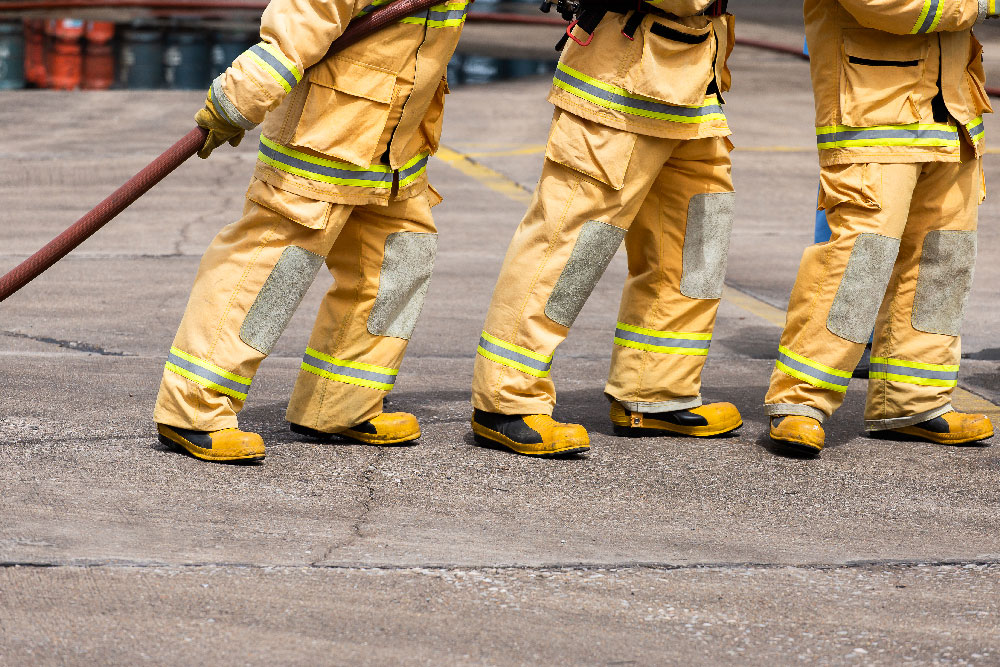
Structural firefighters operate inside burning buildings where peak temperatures, smoke, falling debris, and short-duration extreme heat all converge. The standard ensemble is governed by NFPA 1971 in North America and EN 469 in Europe.
Turnout coat and pants:
Three-layer construction with an outer shell of aramid blends (typically incorporating Nomex, Kevlar, or PBI), a moisture barrier to block water and chemical penetration while allowing vapour transmission, and a thermal liner for insulation. The three layers work together, and the assembly is certified as a complete ensemble.
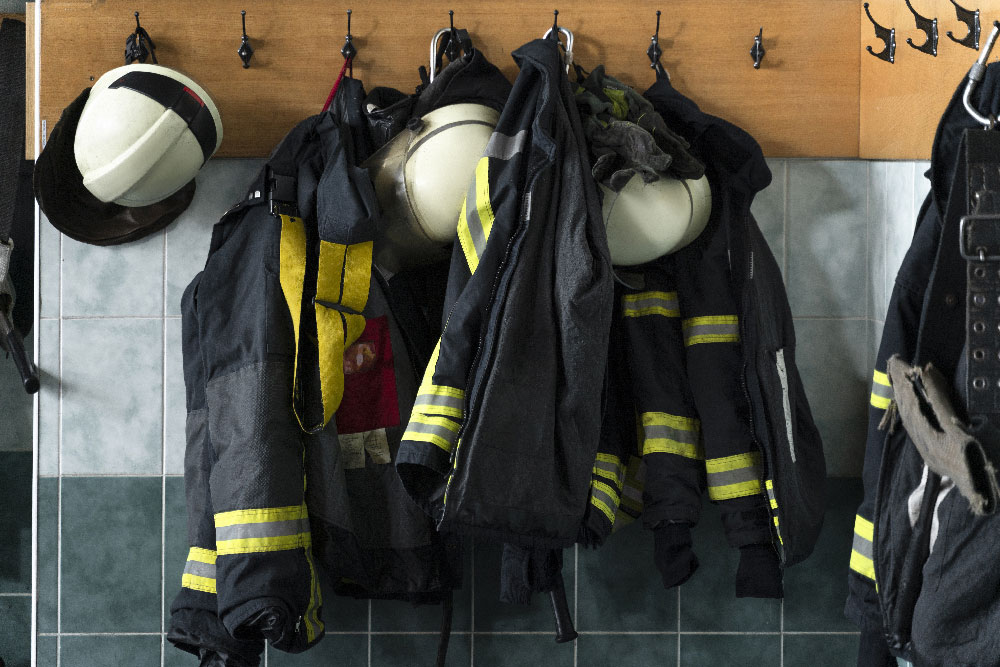
Helmet:
Heat- and impact-resistant shell with face shield or goggles, ear protection, and chinstrap. Helmet colour often indicates rank or role within the team.
Hood (Nomex or PBI):
Worn under the helmet to cover the head, neck, and ears, sealing the gap between collar and helmet. A clean hood interface matters for both thermal protection and to limit particulate exposure.
Gloves:
Heat- and cut-resistant, designed to allow dexterity for hose handling, tool use, and victim extraction. Cuff length matters for the wrist-to-coat seal.
Boots:
Leather or rubber, with steel or composite toe caps, puncture-resistant midsoles, and heat-resistant outsoles. Pull-on designs are common because they can be donned quickly.
SCBA:
Self-contained breathing apparatus is mandatory inside any structural fire because the atmosphere is IDLH (immediately dangerous to life and health). SCBAs are governed by NFPA 1981. Air-purifying respirators are not acceptable for active firefighting under any circumstances. PAPRs may be used in post-fire overhaul once the atmosphere has been tested and confirmed below IDLH thresholds.
Wildland Firefighting
Wildland firefighters work outdoors over extended shifts, often in remote terrain, with lower peak temperatures than structural fires but much longer exposure durations. Heat stress, dehydration, and mobility are the dominant constraints. The relevant standard is NFPA 1977.
Garments:
Single-layer flame-resistant outer fabric (typically Nomex or treated cotton blends) in a shirt-and-trouser configuration. Significantly lighter and more breathable than structural turnout. Designed for sustained physical exertion in heat.
Helmet:
Lightweight hard hat with chinstrap and goggle-compatible design. Wildland helmets are not built for the same impact and heat profiles as structural helmets.
Eye and face protection:
Goggles for embers and dust, with a shroud or bandana to protect the face and neck from radiant heat and airborne particles.
Boots:
Leather, lace-up, ankle-supporting, with non-melting soles. Vibram and similar lug patterns are common for traction on uneven terrain.
Pack and field equipment:
Hand tools, fire shelter (a last-resort heat-reflective enclosure carried for entrapment scenarios), water, and communications. The fire shelter is a critical piece of wildland PPE not found in any other intervention category.
Hazardous Materials Response
Hazmat operations involve chemical, biological, or radiological exposure rather than direct fire. The PPE selection depends entirely on the substance involved and the protection level required. The relevant North American standards are NFPA 1991 (vapour-protective ensembles) and NFPA 1992 (liquid splash-protective ensembles). European equivalents include EN 943 for gas-tight suits and EN 14605 for liquid splash suits.
Encapsulating vapour-tight suits (highest protection):
Fully enclosed, sealed at all junctions, with SCBA worn inside the suit. Used when the atmosphere contains gases or vapours that can be absorbed through skin or that exceed inhalation exposure limits.
Liquid splash suits:
Chemical-resistant outer layer that protects against splash but not vapour. Worn with SCBA or air-purifying respirator depending on the airborne hazard.
Chemical-resistant gloves and boots:
Material selection (butyl, neoprene, nitrile, Viton) depends on the specific chemicals encountered. No single glove material protects against all chemicals.
Respiratory protection:
SCBA for unknown atmospheres or known immediately-dangerous concentrations. APR or PAPR with appropriate cartridges for atmospheres with known contaminants below IDLH thresholds.
Technical Rescue
Technical rescue covers vehicle extrication, structural collapse, confined space, high-angle rope rescue, trench rescue, and water rescue. Each subtype has its own gear emphasis, and the relevant standard is NFPA 1951 for the technical rescue ensemble.
Garments:
Lighter and more mobile than structural turnout. Cut and abrasion resistance matter more than peak thermal protection. Designed to allow harness compatibility and unrestricted movement.
Helmet:
Climbing-style or rescue-specific helmet with chin strap, often with integrated headlamp mount and goggle compatibility. Different from structural helmets, which prioritise heat resistance.
Harness:
Class III full-body harness for high-angle and rope rescue, with attachment points rated to the relevant standard. Saltwater-resistant hardware where the operating environment requires it.
Boots:
Lighter than structural boots, with grip optimised for the surfaces being worked on. Steel toe and puncture-resistant midsole for debris environments.
Specialised additions:
Personal flotation devices for water rescue (NFPA 1952), confined-space communications and atmospheric monitoring equipment, dive gear for underwater operations.
Specialised Operations
Several firefighter roles use further specialised PPE outside the four categories above:
Aircraft rescue and firefighting (ARFF):
Proximity suits with aluminised outer layers reflect high radiant heat from aviation fuel fires. Governed by NFPA 1971 with proximity ensemble certification.
Incident command and support roles:
High-visibility vests, hard hats, and limited PPE appropriate to staying outside the immediate hazard zone.
Dive and ice rescue teams:
Dry suits, surface-supplied air, communications, and specialised harnesses. Equipment configuration is mission-specific.
Wildland-urban interface:
Hybrid kits that combine elements of structural and wildland PPE for crews working where homes and wildland meet. Standards work is ongoing in this category.
Final Thoughts
Firefighter PPE selection is governed by the intervention, not by the rank or general role of the wearer. The five categories covered here overlap at the edges (a wildland-urban interface crew uses elements of both kits, a hazmat ensemble may be worn over a base wildland layer in some configurations), but the fundamental principle holds: gear designed for one type of intervention is not interchangeable with gear designed for another. Procurement decisions made on cost or generic fit alone tend to surface their consequences only on scene.
Explore our firefighting and rescue gear for various intervention types and certification regions.